How Will the New Fleet Actually Work?
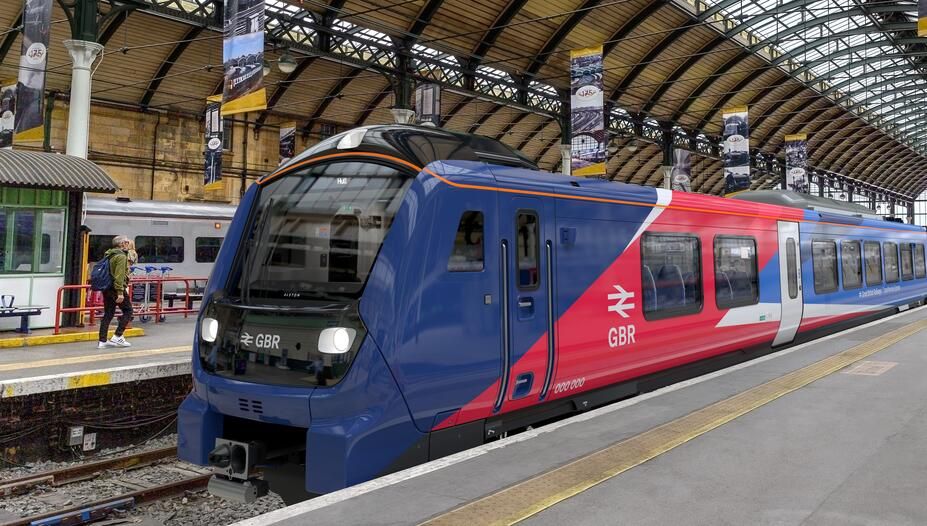
When the Department for Transport announced Alstom as the preferred manufacturer for TransPennine Express’s new battery-electric fleet, one detail immediately stood out.
These won’t simply be electric trains with a battery bolted underneath.
Instead, they represent a completely different way of operating a railway.
Unlike today’s diesel-powered Class 185s, which can operate almost anywhere on the network without relying on external power, the new Alstom fleet has been designed to make the most of the expanding electrified railway while using batteries only where overhead wires don’t yet exist.
That raises an obvious question: how will the trains actually operate across the network?
Charging Where It Matters Most
Rather than installing charging equipment across dozens of stations, TransPennine Express will concentrate battery charging at three strategic destinations:
- Hull
- Scarborough
- Saltburn
These stations effectively become battery hubs for the fleet.
The concept is surprisingly simple. Wherever overhead line equipment (OLE) exists, the trains will operate as conventional electric trains, drawing power directly from the wires while simultaneously recharging their batteries. Once the electrified network ends, the trains will automatically switch to battery power before continuing to their final destination. After arriving, the batteries will be recharged before beginning the return journey.
Hull Services
Under the wires: Liverpool Lime Street → Manchester → Huddersfield → Leeds → Micklefield Junction
On battery: Micklefield Junction → Brough → Hull
Off-wire distance: approximately 41 route miles
For Hull-bound trains, most of the journey will take place beneath the overhead wires. The train will leave Liverpool Lime Street under electric power before continuing through Manchester, Huddersfield and Leeds. After passing Micklefield Junction, the overhead wires end, and the train continues on battery power via Brough before arriving at Hull.
Scarborough Services
Under the wires: Liverpool Lime Street → Manchester → Huddersfield → Leeds → York
On battery: York → Malton → Seamer → Scarborough
Off-wire distance: approximately 42 route miles
Scarborough follows a similar principle. The train will operate under electric power from Liverpool through Manchester, Huddersfield, Leeds and York. East of York, where electrification ends, the train switches to battery power for the journey via Malton and Seamer before arriving at Scarborough.
Saltburn Services
Under the wires: Liverpool Lime Street → Manchester → Huddersfield → Leeds → York → Northallerton
On battery: Northallerton → Eaglescliffe → Middlesbrough → Redcar → Saltburn
Off-wire distance: approximately 39 route miles
The Saltburn route is perhaps the most interesting. Services will operate under the wires as far as Northallerton, beyond which the train relies on battery power through Eaglescliffe, Middlesbrough and Redcar before terminating at Saltburn.
Together, these three routes demonstrate exactly why battery-electric technology has become attractive for TransPennine Express. Instead of waiting decades for every mile of railway to be electrified, operators can use batteries to bridge the remaining gaps while still benefiting from electric operation over the majority of the journey.
Why Are Sixteen Class 185s Staying?
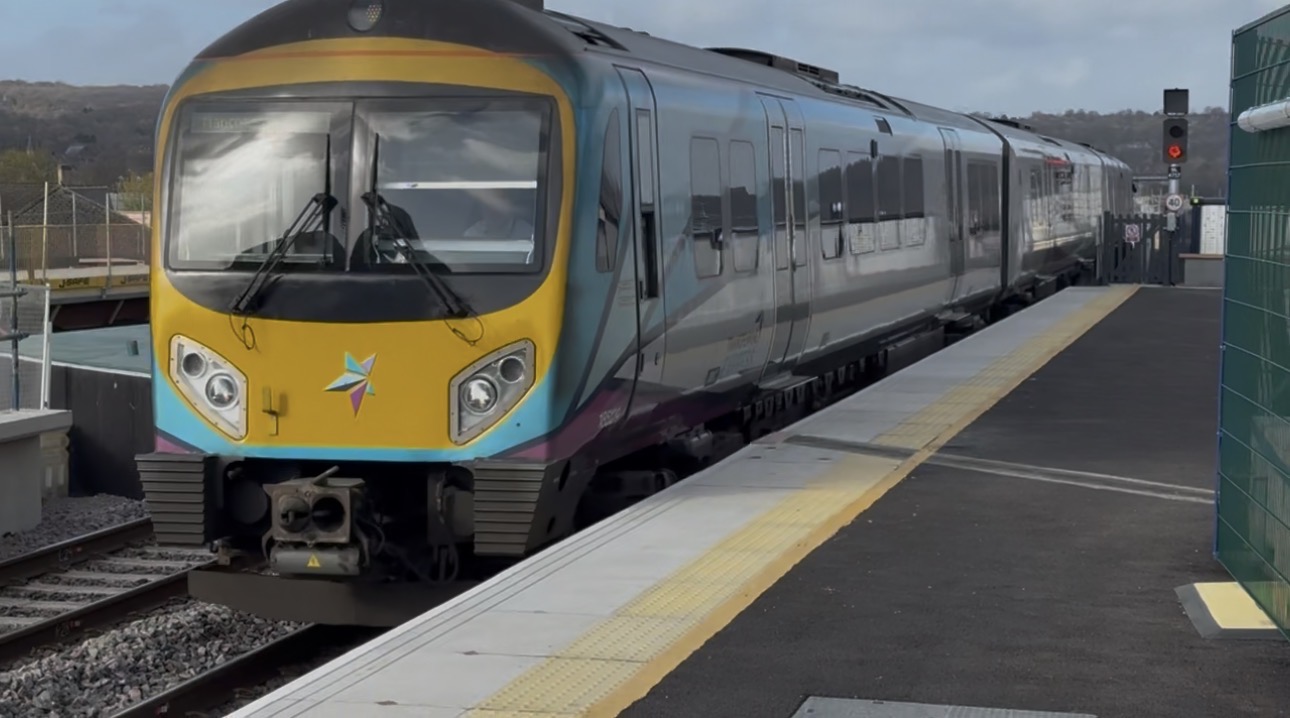
One of the biggest surprises in the announcement was that the Class 185 fleet isn’t disappearing completely — 16 units will remain in service.
The reason becomes clear when looking at the Liverpool Lime Street to Cleethorpes route. Unlike the core TransPennine corridor, this service leaves the electrified West Coast Main Line before continuing through Stockport, Sheffield, Doncaster, Scunthorpe, Grimsby Town and Cleethorpes, much of it without overhead wires.
At present, the route simply contains too much unelectrified railway for the new battery fleet to operate in the same way as the Hull, Scarborough or Saltburn services. Retaining part of the Class 185 fleet therefore provides TransPennine Express with a practical solution while longer-term decisions are made about the future of that corridor.
Far from being a compromise, it reflects the reality that Britain’s railway is still a mixture of electrified and non-electrified infrastructure.
What Will Their BR Class Number Be?
Although the trains have now been announced, they do not yet have an official British Rail TOPS class number. Every modern train introduced to the national network eventually receives a class designation, but these are normally allocated much closer to testing and entry into service.
Until then, the fleet is simply known as Alstom’s new battery-electric trains for TransPennine Express. For railway enthusiasts, guessing the eventual class number will no doubt become a popular discussion over the coming years.
Can the Batteries Really Travel 100 Miles?
This has become one of the most frequently asked questions since the announcement. The honest answer is that we simply don’t know yet.
Alstom has not published the battery capacity, energy storage specification or maximum off-wire range of the new trains. As a result, any figure currently circulating online should be treated with caution.
What we do know is that the trains have been designed specifically for the routes they will operate. The charging locations at Hull, Scarborough and Saltburn have not been chosen at random — they form part of an integrated operating strategy, allowing the trains to recharge at the ends of their journeys before returning under the wires.
Just like an electric car, the real-world range will depend on many factors, including passenger numbers, gradients, weather conditions, heating and air conditioning demand, acceleration, braking and battery age. Until Alstom publishes detailed technical specifications, it is impossible to say exactly how much usable battery range the trains will have.
What Happens During Engineering Work?
One fascinating question remains unanswered. Today’s TransPennine Express services are frequently diverted during engineering work, sometimes via routes such as the Calder Valley, Wakefield Kirkgate or Castleford. These diversionary routes include sections with limited or no overhead electrification.
So what happens if a battery-electric train has to leave its planned route? At present, neither TransPennine Express nor Alstom has explained how these scenarios will be managed. There are several possibilities: the trains may carry sufficient battery reserve to complete certain diversions; temporary charging arrangements could be introduced during planned engineering work; or some services may continue to be operated by retained Class 185s or other diesel traction when extensive diversions are required.
Until detailed operating plans are published, the answer remains one of the biggest outstanding questions surrounding the new fleet.
What Happens to the Class 802 Fleet?
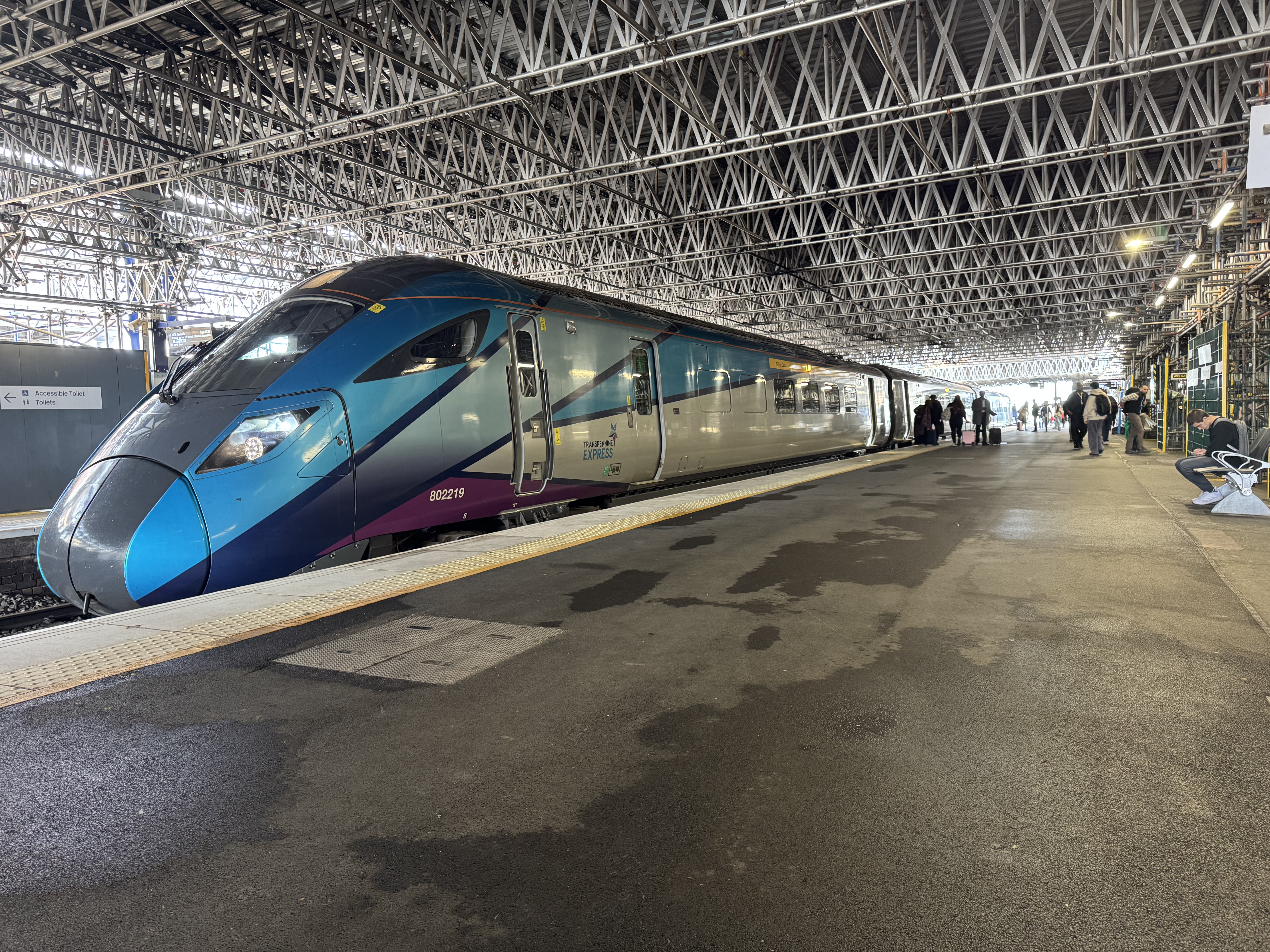
With Alstom’s new battery-electric trains taking over services to Hull, Scarborough and Saltburn, another question naturally follows: what happens to TransPennine Express’s existing Class 802 fleet?
The Nova 1 Class 802s are among the youngest trains in the operator’s fleet and remain ideally suited to long-distance inter-city services. Originally ordered to strengthen TransPennine Express’s links between Liverpool, Manchester, Leeds, Newcastle and Edinburgh, they have always worked diagrams extending north of Newcastle — even though passengers currently see these advertised as separate Liverpool–Newcastle and Newcastle–Edinburgh services.
In practice, this means that some Class 802 units already operate continuously between Edinburgh and Liverpool Lime Street through their daily diagrams. While passengers are normally required to leave the train at Newcastle because the timetable treats the journey as two separate services, the train itself often continues beyond the terminus to form the next working.
Could Liverpool and Edinburgh Become One Through Service?
Once the new Alstom battery-electric fleet assumes responsibility for services to Hull, Scarborough and Saltburn, the Class 802 fleet will become increasingly focused on long-distance routes. From an operational perspective, a dedicated Liverpool Lime Street–Edinburgh service would make considerable sense.
It would:
- Create a clear role for the Class 802 fleet as TransPennine Express’s principal long-distance inter-city train.
- Remove the need for passengers travelling between Liverpool, Manchester, Leeds and Edinburgh to change trains at Newcastle.
- Simplify fleet allocation by concentrating the bi-mode fleet on routes requiring long-distance capability.
Because Class 802 units already work through diagrams linking Liverpool and Edinburgh, introducing a through passenger service would not necessarily require additional trains. The more significant changes would be to the public timetable, crew diagrams and operational planning rather than the rolling stock itself.
Why Might the Services Remain Split?
There are, however, good reasons why TransPennine Express may continue to divide the route at Newcastle. A Liverpool–Edinburgh service would cover more than 250 miles. Delays encountered leaving Liverpool or Manchester could easily affect the Scottish section several hours later, reducing punctuality across the East Coast Main Line.
Newcastle also provides a convenient location for crew changes, timetable regulation and service recovery. Separating the service allows delays to be contained more effectively, improving reliability for passengers joining further north. For these reasons, retaining two separate passenger services may continue to offer operational advantages, even if the same physical train works both portions of the route.
Our View
Although TransPennine Express has announced no plans to merge the two services, the arrival of the new Alstom fleet creates an opportunity to reconsider how the Class 802s are deployed. If the battery-electric fleet becomes responsible for Hull, Scarborough and Saltburn, a dedicated Liverpool Lime Street–Edinburgh service operated by the Class 802 fleet would represent a logical evolution of the network. Whether that ultimately happens will depend on timetable planning, performance modelling and operational priorities rather than the capability of the trains themselves.
← Back to On Track With Tim