Nine days at Church Fenton and the next TRU electrification milestone
A complete railway closure from 24 October to 1 November will allow engineers to install the main structure of a new bridge at Church Fenton. The work removes a major physical constraint on electrification – but does it also point to the wires towards Micklefield being switched on at Christmas?
For nine days, one of the most strategically important junctions on the eastern TransPennine route will be taken out of passenger use. From Saturday 24 October until Sunday 1 November 2026, all railway lines through Church Fenton will close while the Transpennine Route Upgrade installs the main elements of the replacement Common Lane bridge.
The blockade is not simply a bridge renewal. It is an electrification job, a civil-engineering job and an operational railway job compressed into one possession. Its importance becomes clearer when Church Fenton is viewed as the meeting point of routes towards Leeds and Micklefield, York and Ulleskelf, and Selby, Hull and Sheffield.
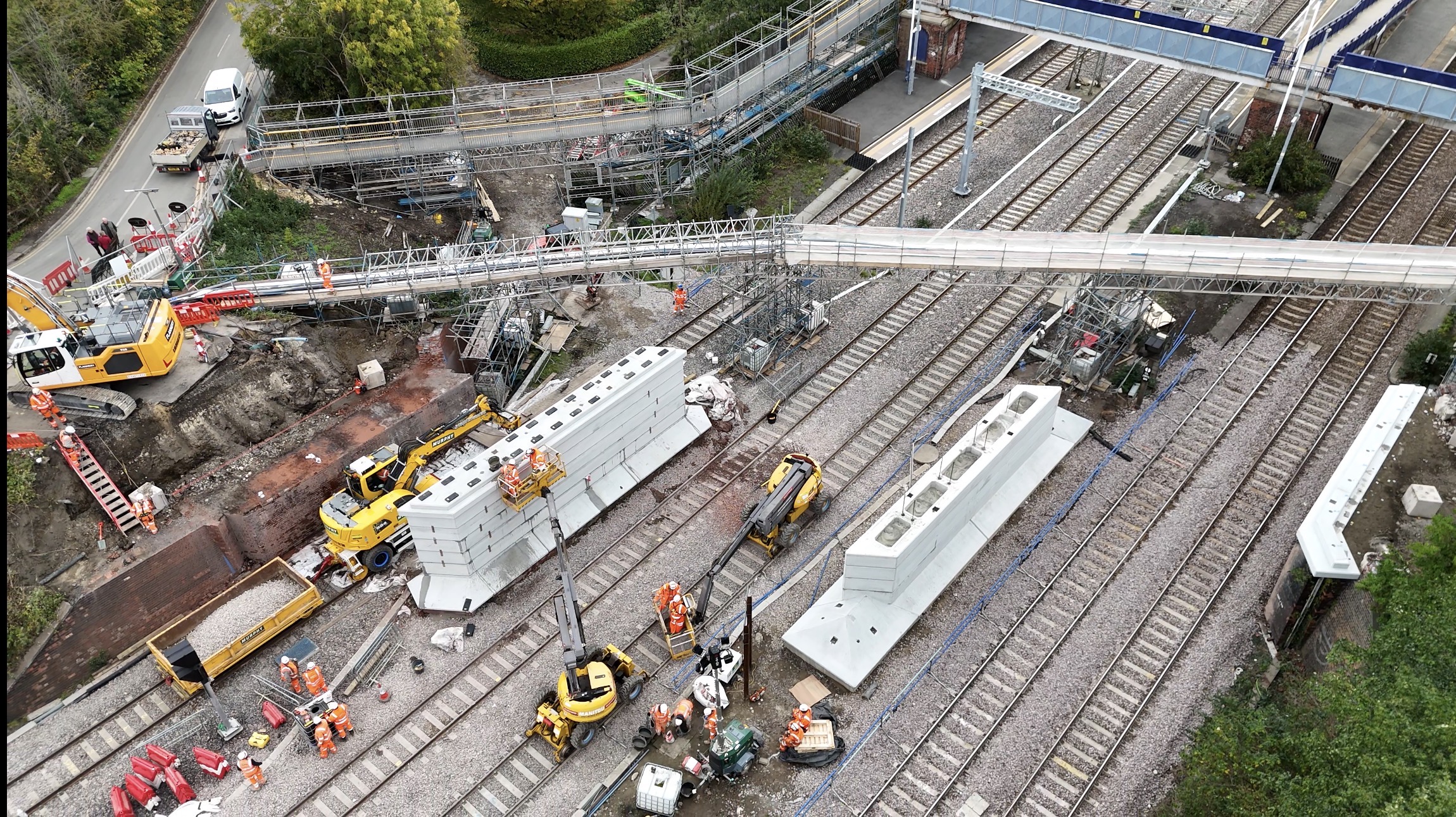
New precast abutments in position between the tracks at Church Fenton, with the old brick structure cleared and engineers working around the clock to prepare for the main beam installation. October 2026.
Why the old bridge had to go
The old Common Lane structure dated from around 1900 and was approaching the end of its useful life. It also sat too low above the railway to accommodate the overhead line equipment required for the wider TRU electrification scheme. Rather than renew the bridge later and create another major disruption, TRU brought the replacement forward by a year, solving two problems at once: removing an ageing asset and providing the electrical clearance needed for the future 25 kV overhead system.
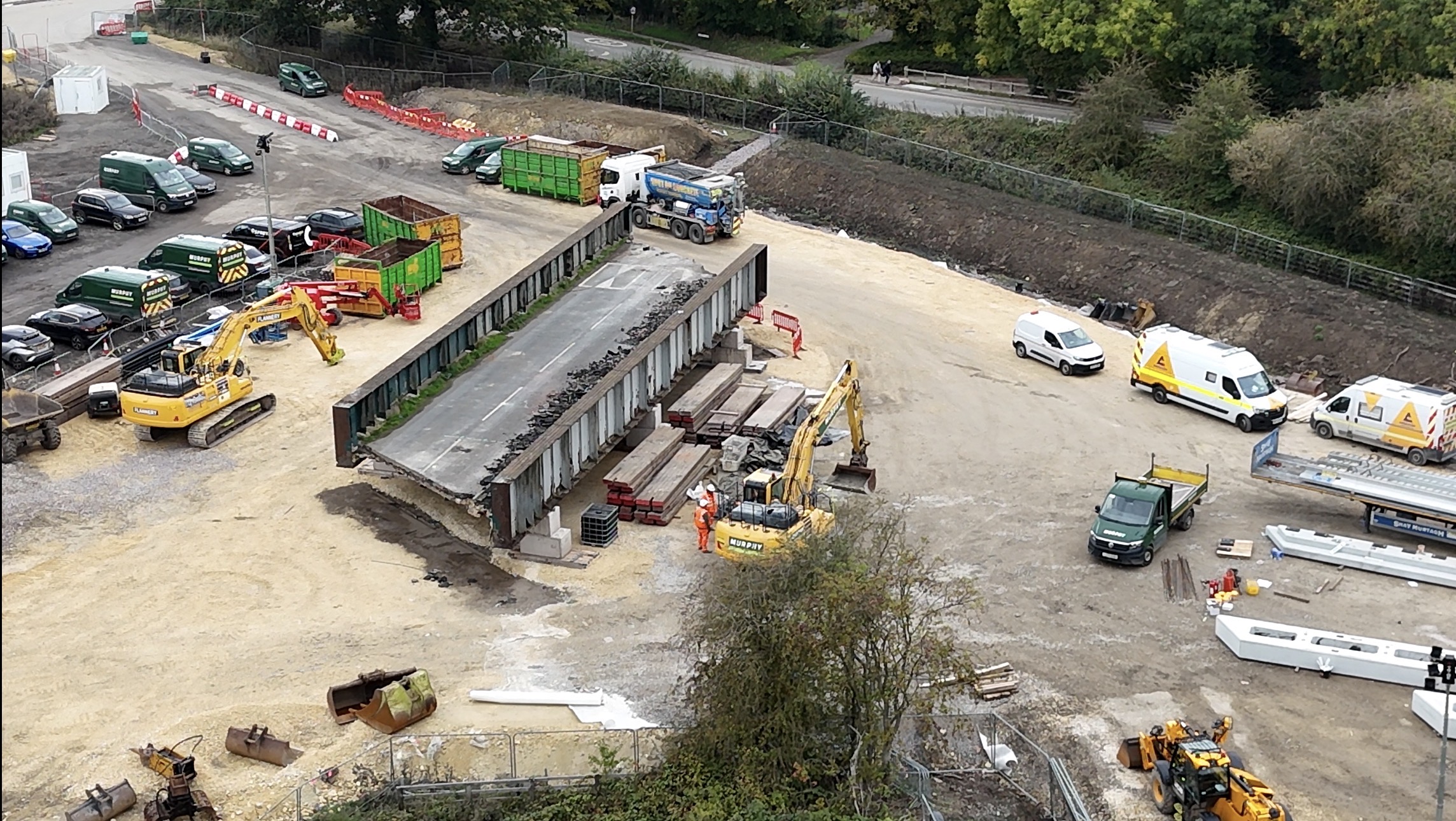
The old Common Lane deck, removed from the railway and waiting in the compound. The original structure dated from around 1900 and lacked the clearance height needed for 25 kV overhead line equipment.
Preparatory work has already involved diverting water, electricity, sewer and telecommunications services onto a temporary structure. The published programme scheduled removal of the original bridge deck and brick arch section for 10 and 11 October, followed by installation of the first section of the new bridge on 17 and 18 October.
What happens during the nine-day blockade
The main installation between 24 October and 1 November covers the remaining bridge beams, the deck and parapets, together with supports for the overhead line equipment. Engineers will work around the clock while trains are kept away from every line through the junction.
The road above will not reopen immediately. Waterproofing and further structural work are scheduled to continue through December. Utilities are then due to be transferred back onto the permanent bridge between January and April 2027, with Common Lane scheduled to reopen to traffic and pedestrians on 5 June 2027.
That long finishing programme does not diminish the railway milestone. Once the main structure is in place, the route gains the physical envelope and support arrangements needed to complete the electrification interface through this constrained location.
Why passengers will feel the impact well beyond Church Fenton
No trains will run between Leeds and York during the nine-day closure. Direct replacement buses will operate between York and Leeds and between York and Selby, while stopping buses will link York, Ulleskelf, Church Fenton, Sherburn-in-Elmet and Micklefield. At Micklefield, passengers can connect with local trains for Leeds.
The two weekends are more complicated, because separate East Coast Main Line work will also replace trains between Darlington, York and Doncaster. For passengers, this is not a normal local possession. It removes the principal Leeds-York railway and restricts north-south travel through York at the same time.
The electrical railway is already approaching from both sides
To the east, the overhead line equipment from Colton Junction to Church Fenton North, including Ulleskelf, has been live at 25,000 volts since 7 July 2024. That established the first substantial electrified section at the York end of TRU.
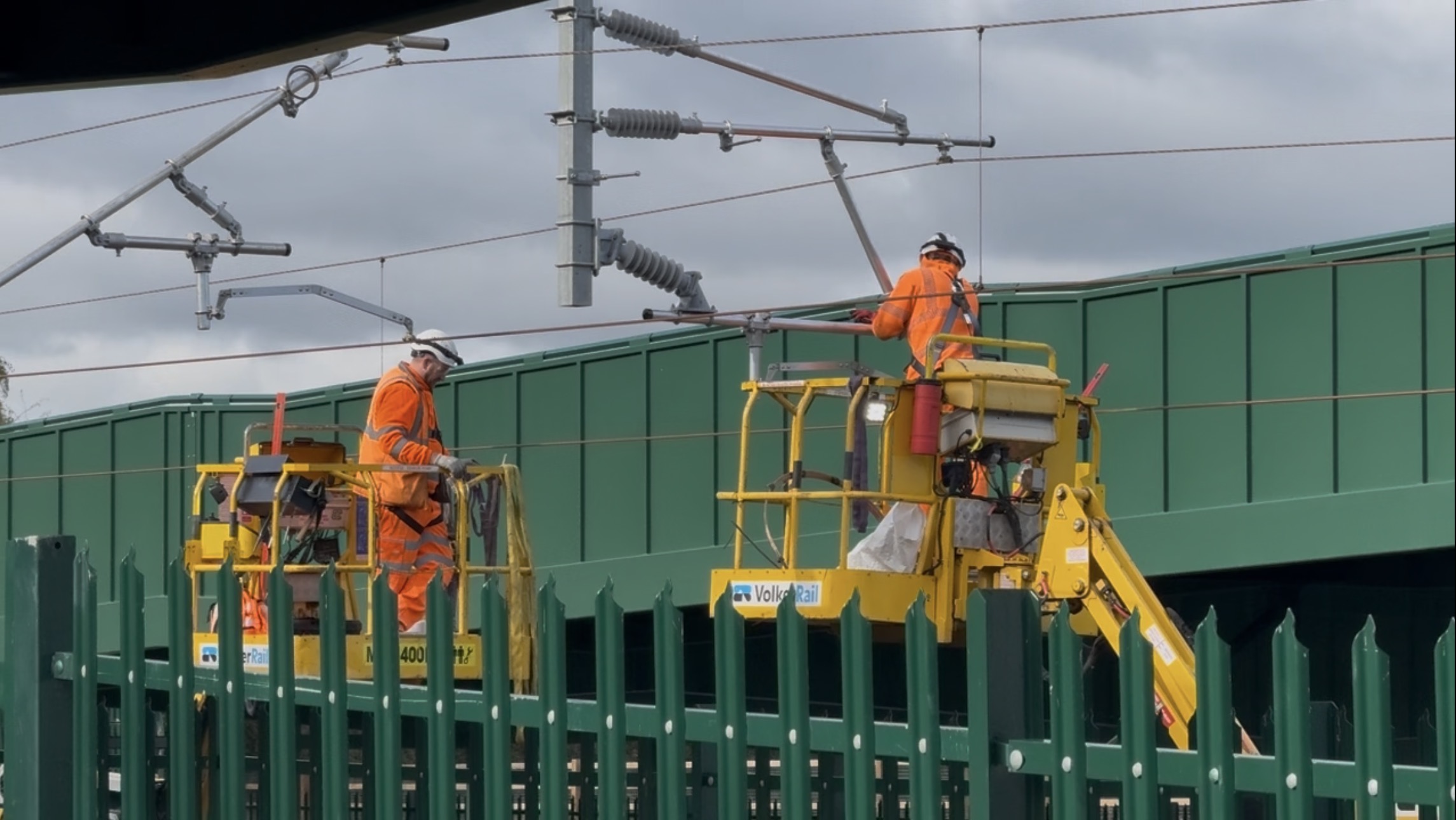
Volker Rail engineers on MEWPs working on the overhead line equipment west of Garforth station. The wiring programme between Micklefield and Church Fenton is well advanced, though energisation is a separate milestone from installation.
To the west, the physical wiring is much further advanced than many passengers may realise. TRU reported in July 2025 that 7.5 kilometres of overhead wiring had been completed between Micklefield and Church Fenton. But the route also requires the less visible electrical infrastructure: high-voltage cabling, switching equipment, track sectioning, signalling compatibility, testing and formal safety assurance.
That distinction matters. Installing wires is not the same as energising them, and energising them is not automatically the same as introducing a new all-electric passenger service. Each is a separate project milestone.
Could Micklefield to Church Fenton go live at Christmas 2026?
There is an emerging expectation that the Church Fenton to Micklefield section could be energised around Christmas 2026. The timing is plausible: much of the wiring is already installed, the new Common Lane bridge removes a major clearance constraint, and the end of the year offers established railway access for testing and commissioning work.
As of 19 October 2026, TRU and Network Rail have not published a public energisation notice confirming that date. The official material for the October blockade says the bridge will accommodate the overhead equipment needed for future electric trains, and does not say the section will definitely become live at Christmas. Christmas energisation is a credible possibility, not yet a confirmed commitment.
A formal switch-on would normally be accompanied by safety communications to railway staff, contractors and lineside communities, because the equipment must then be treated as live at all times.
What a Christmas switch-on would mean
If the section is energised, it would extend the live 25 kV railway west from Church Fenton towards Micklefield and close an important gap in the eastern electrification programme. It would demonstrate that TRU is moving from visible construction into systems integration, including power, signalling, clearances and operating rules working as one railway.
It would not, by itself, mean the whole Leeds-York route was ready for electric-only operation. Further work remains west of Micklefield and towards Leeds, including bridge reconstruction, overhead equipment and the larger Leeds to Micklefield upgrade. Bi-mode trains can use completed electrified sections before an uninterrupted electric railway is available, but the operational benefit depends on the timetable, traction strategy and commissioned limits.
The engineering story to watch
The headline image from Church Fenton will be a new bridge lowered into position. The deeper story is the sequence beneath it: an Edwardian structure removed, utilities temporarily displaced, a modern deck built around railway clearances, overhead supports incorporated, and a junction prepared for a high-voltage railway.
By the time trains return on Monday 2 November, the bridge will still need months of work above track level. But below it, one of the clearest physical obstacles to the next electrified section should have been removed. The next question is no longer whether the wires exist between Church Fenton and Micklefield. It is when Network Rail will declare them live.
Sources
TRU Common Lane bridge project and blockade timetable · Network Rail service and engineering notice, 9 October 2026 · TRU report on 7.5 km of wiring between Micklefield and Church Fenton · TRU Church Fenton North energisation notice, July 2024