Should Great British Railways own its trains?
The Transport Secretary has opened the door to publicly owned rolling stock. Could buying trains save money, and what does TRU’s latest woodland investment tell us about planning a railway for the long term?
A publicly owned railway sounds straightforward. But who actually owns the trains?
That question sits at the heart of a change outlined by Transport Secretary Heidi Alexander in her statement to Parliament on 12 October. Under the government’s new rolling stock and infrastructure strategy, Great British Railways will assess whether buying new trains, leasing them or using another financing arrangement offers the best value. The strategy was published on 28 September and opens the door to public ownership of future fleets, while existing leasing contracts continue.
For passengers watching billions being invested in new trains, the obvious question is: would owning them be cheaper?
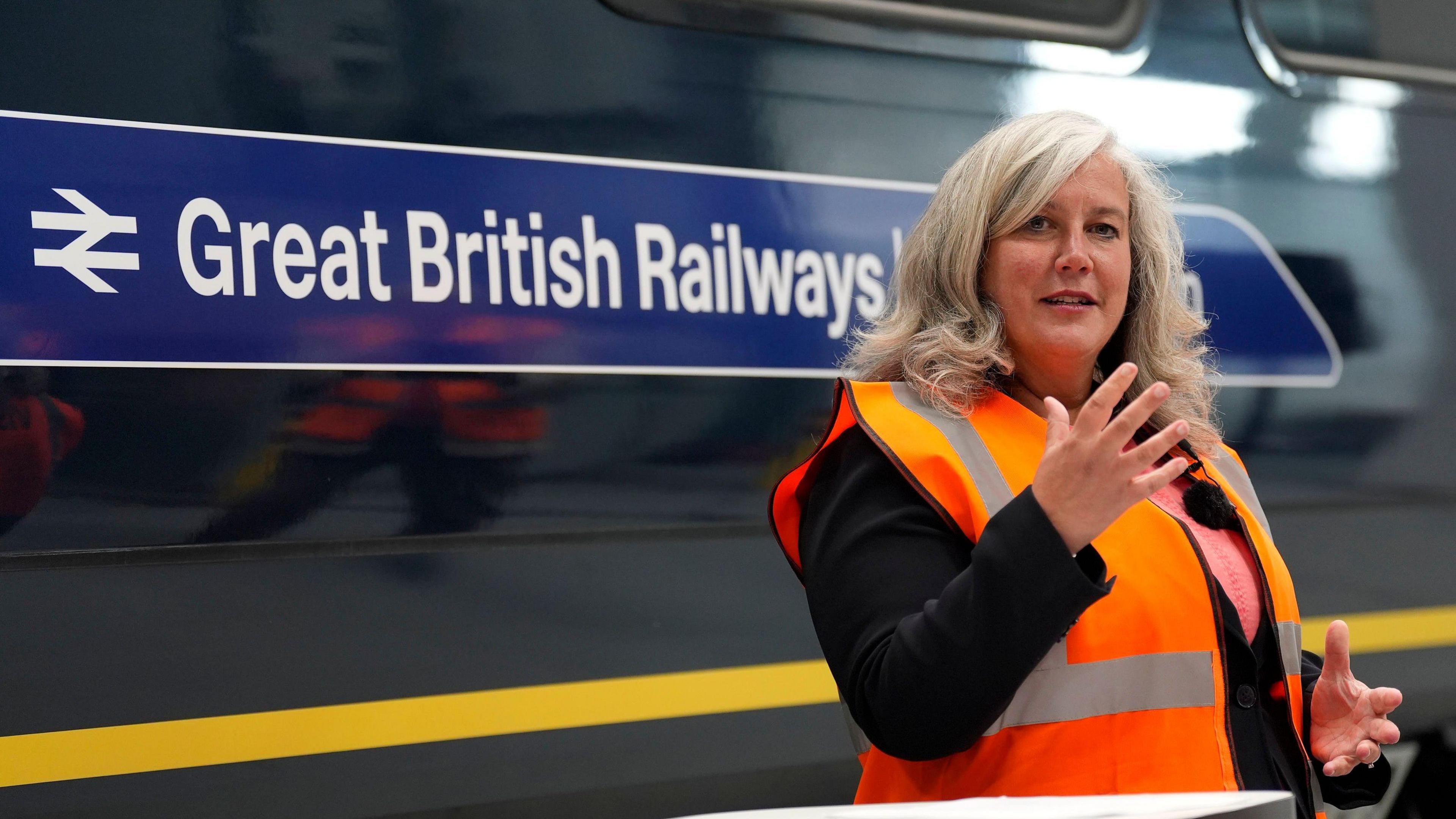
Transport Secretary Heidi Alexander at the announcement of the new rolling stock and infrastructure strategy. Image: BBC.
Why does the railway rent its trains?
Most passenger trains have historically belonged to rolling stock companies, often called ROSCOs. These companies buy trains and lease them to operators. Think of the distinction between a delivery business and its vans: the business might employ the drivers and organise the deliveries, while another company owns the vehicles.
Bringing a train operator into public ownership therefore does not automatically bring its fleet into public ownership. The lease remains a separate arrangement.
The government says annual train leasing and maintenance costs exceed £4 billion. That figure includes essential maintenance, so it would be misleading to describe the entire amount as money that could disappear if GBR bought its trains.
Could buying trains save money?
There is a reasonable financial case for GBR owning some future fleets. A private owner must recover the purchase price, financing costs, management expenses and its return on investment through the lease. Public ownership could avoid paying that private ownership margin, particularly where GBR expects to use a fleet for decades.
Ownership could also give GBR more freedom over refurbishment, modifications and moving trains between services, subject to their technical compatibility.
But buying does not remove the cost of the train. Public money still has to fund its construction, maintenance, major overhauls and eventual replacement. If borrowing is involved, that carries a cost too. It also changes who carries the risk. If a fleet becomes surplus, proves unreliable or needs expensive modifications, a public owner must manage the consequences. Leasing can transfer some risks to another party, although the value of that transfer depends on the contract.
The sensible comparison is therefore the total cost over the fleet’s working life, including financing, maintenance and the value remaining at the end. A low purchase price can still produce an expensive train to operate.
Public ownership deserves serious consideration where there is a clear, lasting need for the fleet. However, the available announcements do not establish a reliable saving for any particular order.
Ownership is only part of the bill
Maintenance deserves just as much attention. In April, the Office of Rail and Road launched a review examining long-term rolling stock maintenance arrangements. Its scope includes cost transparency, competition when contracts are renewed and access to depots.
That matters because a publicly owned train could still be tied to an expensive maintenance agreement. Who owns the vehicle and who maintains it are separate decisions, and both affect value for money.
What does this mean for TPE and Northern?
TPE’s new Alstom battery-electric fleet provides a useful example. The September announcement involved Rock Rail financing the project, alongside contracts for train supply and long-term maintenance. The new government strategy does not announce a change to that deal.
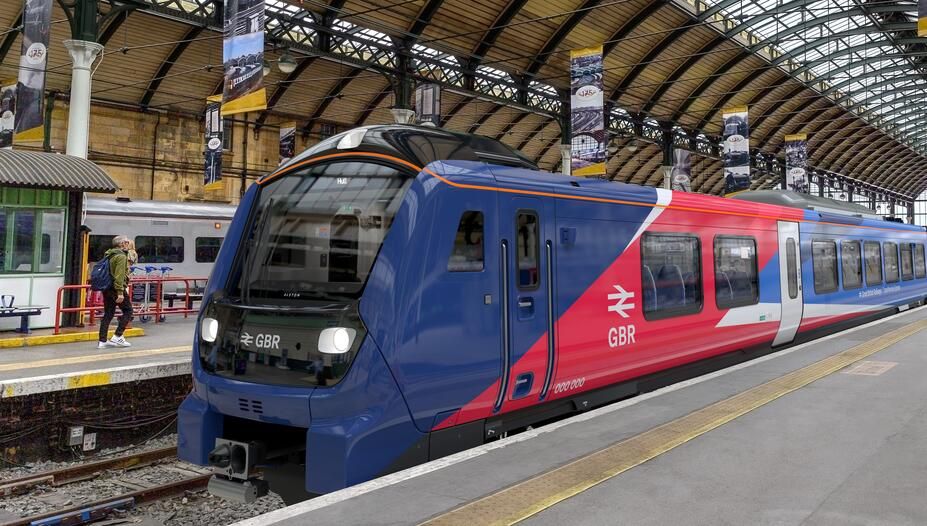
An Alstom Adesia Stream in GBR livery. TPE’s new battery-electric fleet is being financed by Rock Rail, with separate contracts for supply and long-term maintenance. Image: Alstom / TransPennine Express.
The more interesting question concerns future procurement, including Northern’s fleet replacement programme: how will the government compare public purchase with leasing?
There is another potential saving in the strategy. GBR intends to develop a smaller number of train “families”, with more consistent specifications, and coordinate decisions about trains, depots, maintenance and infrastructure. In practical terms, that could mean fewer unnecessary differences between fleets, more shared expertise and better coordination between train deliveries and the infrastructure they need. These are potential benefits, rather than savings already demonstrated.
For TRU, the relationship is easy to understand. Battery trains, overhead wires, charging equipment and depots must work together. Buying each element separately without considering the others risks creating an expensive mismatch.
Meanwhile, TRU is investing in woodland
Alongside the debate over train ownership, a separate announcement shows how railway investment can create benefits beyond the tracks. On 15 October, Network Rail confirmed that TRU had bought 26 biodiversity units from Leeds City Council, supporting improvements across 8.32 hectares at Barnbow Woods and Barnbow Hall Woods, near Cross Gates.
The purchase funds a 30-year habitat programme. Work began in May 2025 and is expected to continue until at least 2055. It is TRU’s first delivery of biodiversity units and contributes towards the programme’s target of a 10% biodiversity net gain.
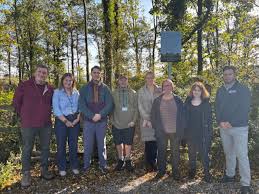
Representatives from Network Rail, TRU and Leeds City Council, including Councillor Katie Dye, at Barnbow Woods to mark TRU’s purchase of 26 biodiversity units. Image: Network Rail.
What is a biodiversity unit?
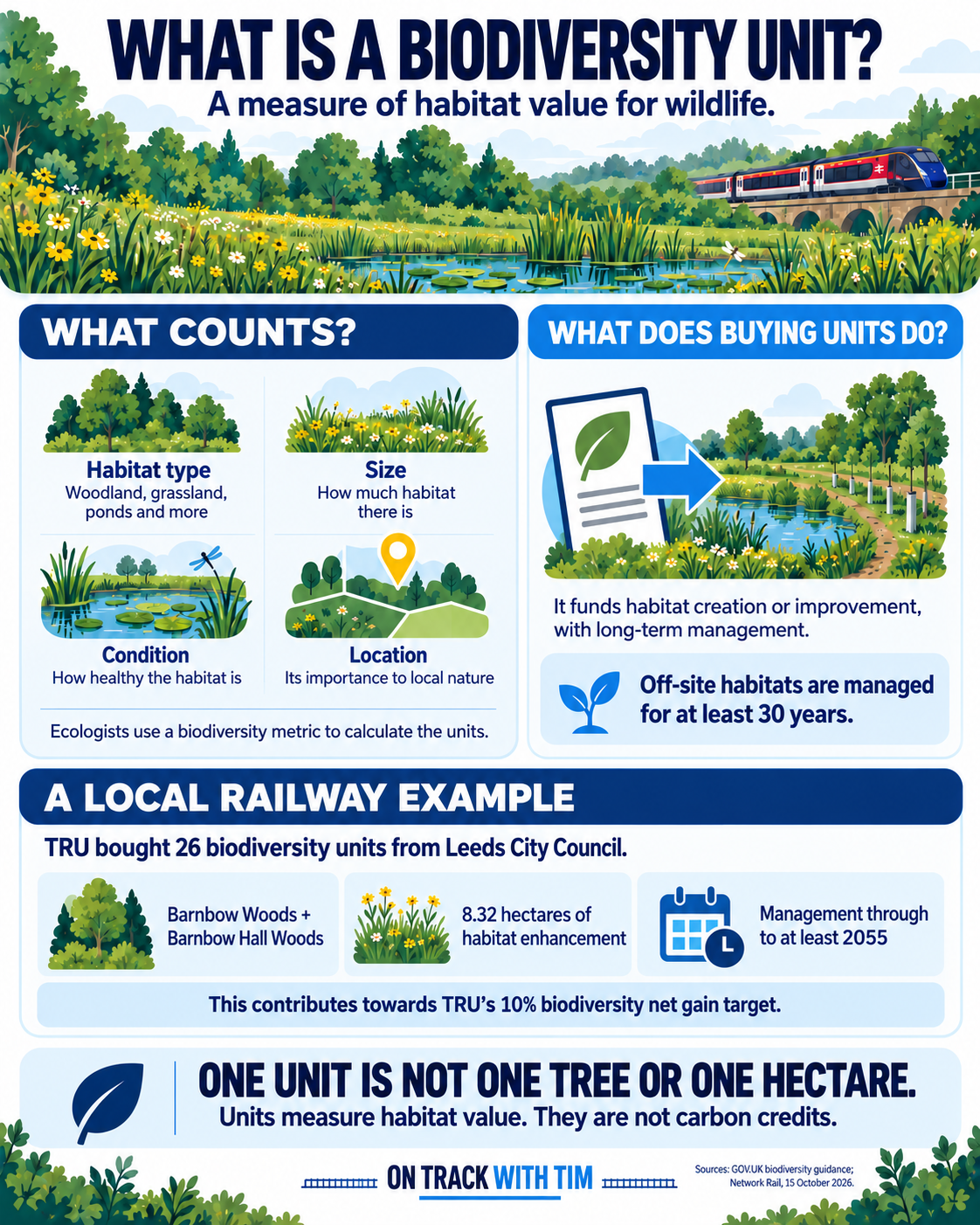
A biodiversity unit measures habitat value, not individual trees or hectares. Buying units funds long-term habitat management off-site. Infographic: On Track With Tim.
What will change at Barnbow?
The woodland programme includes enrichment planting, which adds suitable plants to improve habitat diversity, and specialist work to develop features associated with older trees. The aim is to support a richer woodland ecosystem over time. Network Rail also identifies potential benefits from carbon storage, natural filtering of pollutants and reduced flood risk. Public footpaths provide opportunities for people to enjoy the woodland and learn about wildlife.
Those benefits need careful interpretation. The announcement does not demonstrate that this woodland scheme will prevent flooding on a particular railway section. Its contribution will depend on the land, its management and the surrounding catchment. Nor does purchasing 26 units mean TRU has already achieved its entire biodiversity target. The purchase is one contribution towards that wider commitment.
Will the investment deliver?
For woodland, success takes years to become visible. The useful questions are whether planting establishes, habitat condition improves and the promised management continues. That makes monitoring as important as the initial purchase. The value lies in what happens on the ground through to 2055.
The same long view should apply to rolling stock. A train ownership decision made today can shape railway costs for decades. GBR owning future trains could offer better value in the right circumstances. TRU’s woodland investment could leave a lasting environmental benefit. Both deserve to be judged through clear evidence of what they deliver over their lifetime.
For passengers and communities, that is the real test: whether today’s spending creates a railway, and a surrounding environment, that serves the next generation better.
← Back to On Track With Tim